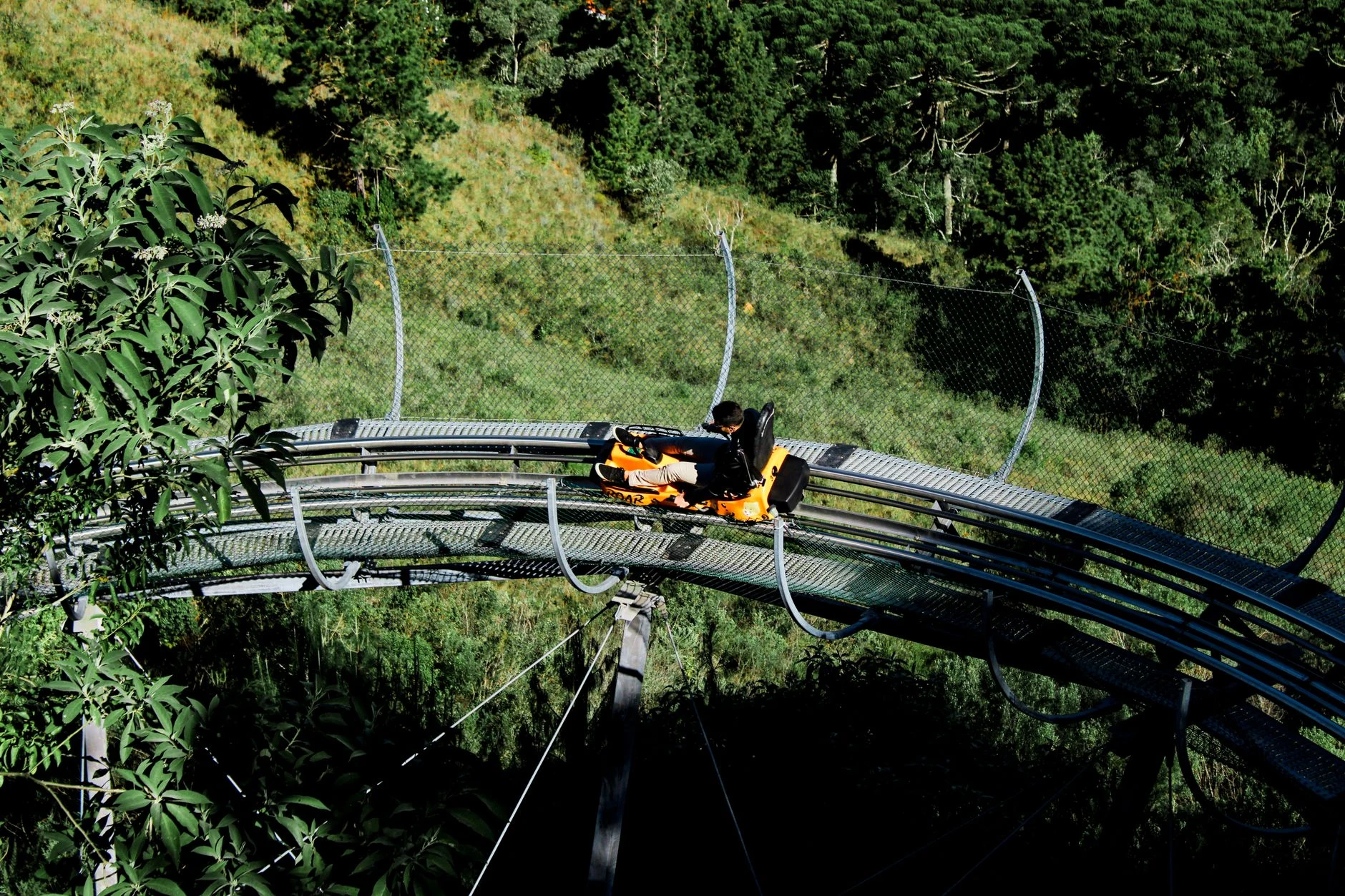
Lift-served mountain biking turns a ski area into a bike park. A chairlift fitted with carriers takes riders and bikes to the top, and the ski trails become descents — some of them cut as single track through the trees, others left as wide, fast runs down open slope.
The Berkshire hills offer the most developed lift-served riding in western Massachusetts. It is also the form of cycling with the steepest entry requirements, and the one where turning up unprepared has the most immediate consequences.
This is not trail riding
The distinction matters and is regularly missed by people who ride confidently on ordinary trails.
Downhill riding at a bike park involves sustained steep descent, loose surfaces, roots, rocks, jumps and berms, ridden at speeds well above cross-country pace. There is no climbing, which removes the fitness element and removes the natural brake it imposes on speed.
The consequence is that the crashes are faster and the terrain is less forgiving. Some prior mountain biking experience is genuinely a requirement rather than a recommendation, and most operators say so.
Anyone whose riding is on rail trails and forest roads should not make a bike park their introduction to off-road descent. There is excellent gentler riding in the county — the Ashuwillticook Rail Trail and similar routes among them — and it is the right place to start.
Protection, bikes and season
Helmets are required and enforced. A full-face helmet is strongly preferable to an open one for downhill. Skin on a chin does not survive a face-first slide.
Gloves, always. Hands go out first in every fall.
Knee and elbow pads are the difference between a bad day and a bad month. They are cheap, they rent, and every experienced rider wears them.
Eye protection. Grit thrown up by the rider in front, at speed, into an unprotected eye is a common and entirely avoidable end to a day.
Body armour and neck braces are used by riders on the harder trails and are worth considering for anyone progressing beyond the easiest descents.
Bikes and rentals
A cross-country bike is the wrong tool. Downhill trails demand long-travel suspension, powerful brakes and strong wheels, and a lightweight bike built for climbing will be damaged or will fail — usually at the worst moment.
Rental fleets at bike parks carry appropriate machines, and for anyone riding a handful of days a season that is the sensible route. It also removes the transport problem, which for a bike that heavy is not trivial.
Riders bringing a bike should check that it will fit the lift carriers, and should have the brakes serviced beforehand. Sustained descent generates far more heat in a brake than ordinary riding, and marginal pads become no pads halfway down.
When it runs
The season generally opens in late May and runs to autumn, with the lift operating weekends and holidays at either end and more frequently in high summer. The precise hours are narrower than the ski-season equivalent, often starting late morning.
Wet weather is the variable. Rain does not close a bike park, but it changes the trails completely — roots become unrideable and the surface loosens. Riders comfortable in the dry are frequently out of their depth on the same trail in the wet.
The rest of the mountain's summer operation, including the attractions suitable for the non-riding half of a group, is covered on summer.
Cross-country and gentler options
Not all Berkshire mountain biking is downhill. The county has a large network of forest trails, and a good deal of it is rideable at a pace that has nothing to do with bike parks.
The state forests carry the bulk of it. Signage is adequate rather than generous and phone coverage is patchy, so a map that does not depend on a signal is worth carrying — the same caveat that applies to walking, covered on hiking.
Rail trails offer flat, surfaced riding suitable for any bike and any age, which makes them the answer for a family with mixed abilities. The broader range of warm-weather activity in the county is on outdoors and more things to do.
Reading a trail grade
Bike parks grade their descents in much the same way ski areas grade their trails, and with the same letters and colours. The grades are not transferable between the two, and they are not transferable between parks either.
A green descent at a bike park is wide, smooth and free of features that require the wheels to leave the ground. It is the right place for a competent trail rider making a first descent, and it is not trivial.
A blue descent introduces built features — berms, small jumps with rollable alternatives, rock sections — at a size that can be ridden over rather than jumped. Most riders spend most of their time here.
Black and beyond involve features that must be committed to. A jump with no roll-over line has to be cleared, and a rider who hesitates in the middle of one gets hurt. This is where the difference between confidence and competence becomes expensive.
The sensible progression is to ride a descent slowly before riding it quickly, and to walk any feature that looks doubtful. Every serious rider walks features. Nobody watching thinks anything of it.
The first day, practically
Take the first run at half the speed that feels natural. Trails read completely differently at speed, and a rider who has seen the line once descends far better the second time.
Set the suspension before the first lift rather than at the top of the third run. Rental staff will set sag for a rider's weight in two minutes, and a bike set for someone forty pounds heavier is unpleasant and slow.
Lower the saddle. It should be out of the way, not in a pedalling position — a saddle at climbing height prevents the rider moving behind it, which is the fundamental defensive position on anything steep.
Drink more than seems necessary. There is no climbing to signal effort, so riders routinely finish a day of downhill badly dehydrated without noticing they worked.
Stop before fatigue. Arm pump and tired hands compromise braking, and braking is the whole safety margin. The last run of the day is when most bike park injuries happen, for exactly the same reason it is on skis — a pattern covered on tips for a first day on the slopes.